News
LATEST NEWS AND EVENTS FROM THE SCHOOL OF ENGINEERING
Research leaves the lab to connect with the public in a new edition of Pint of Science
Researchers from Cima, Tecnun, Ceit the School Pharmacy and Nutrition shared with the public the latest advances in cancer, gene therapy, neuroscience, nanomedicine, sustainability, recycling, and quantum computing during this international festival of knowledge dissemination
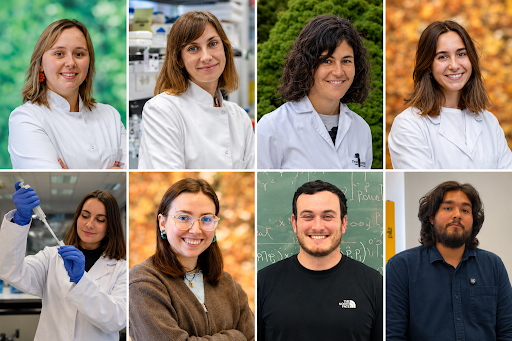
Photo by ManuelCastells/From left to right: Amaia Úriz, Carmen Unzu, Karmele Valencia, Paula Escalada, Leyre Huarte, Nere Arroniz, Josu Etxezarreta, and Frank A. Ricardo.
04 | 06 | 2026
academic research reached out to the public in a new edition of Pint of Science, the international festival of knowledge dissemination held May 18–20 in 108 Spanish cities. Researchers from the University of Navarra participated in the activities organized in Pamplona and San Sebastián to share with the public some of the scientific projects and challenges they are working on.
Through informal discussions, participants were able to learn firsthand about the latest developments in research across a wide range of fields, including cancer, gene therapy, sustainability, the Economics , and quantum technologies.
Biomedical research to better understand and treat diseases
Health research played a prominent role, with the participation of female researchers from the Cima of Navarra and the School Pharmacy and Nutrition.
Amaia Úriz, a researcher with the group Cellular Stress and Immunotherapy in Liver Cancer, discussed the development liver cancer and the role played by the immune system in this disease. During her presentation, she explained how immunotherapies work—one of the most promising therapeutic strategies in oncology—and reviewed the process these treatments follow from laboratory research to clinical application.
For her part, Carmen Unzu, a researcher in the Gene Therapy for Hereditary Hearing Loss and AAV Engineering, introduced the audience to the possibilities of gene therapy for treating diseases caused by DNA alterations. The researcher explained how certain biotechnological tools allow therapeutic genes to be delivered to cells with the goal correcting the root cause of certain diseases.
Researcher Karmele Valencia, from the group Therapeutic Innovation in Lung Cancer, focused her talk on the mechanisms tumor cells use to survive and adapt to adverse conditions. Through her research on lung cancer, she demonstrated how some tumors develop strategies that allow them to resist even advanced treatments such as immunotherapy.
Paula Escalada, a doctoral student in the department Pharmaceutical Sciences at the School Pharmacy and Nutrition, who explained to the audience the role of astrocytes, brain cells that are essential for regulating the brain’s energy metabolism. Her presentation addressed how these cells influence processes such as learning and report what role they might play in neurodegenerative diseases such as Alzheimer’s.
Finally, Leyre Huarte, also a doctoral student in department Pharmaceutical Sciences, discussed the challenges posed by the treatment of pediatric gliomas, the most common type of brain tumor affecting the central nervous system in children. During her presentation, she outlined the potential of nanomedicine to develop more precise therapies and reduce the side effects associated with conventional treatments.
Solutions for a more sustainable society
The sessions held in San Sebastián also included the participation of researchers from Tecnun of Engineering and Ceit who shared projects related to sustainability, digitalization, and emerging technologies.
Nere Arroniz, a researcher with the group Sustainable Improvement at Tecnun, presented her work on improving freight transport in Gipuzkoa using digital tools that enable the analysis of different logistics scenarios. Her research examines how to strengthen local supply chains and promote more sustainable distribution models.
Also from Tecnun, Josu Etxezarreta, researcher Quantum Information Lab (QIL), explained some of the challenges facing quantum computing, particularly error correction, a core topic the reliable application of this technology in fields such as industry, healthcare, and the development new materials.
On behalf of Ceit, Frank A. Ricardo, researcher in computer vision and machine learning, demonstrated how robotics and artificial intelligence can contribute to the advanced recycling of devices such as electric scooters. His research focuses on the automated recovery of critical materials needed for numerous energy transition technologies.
Similarly, Eric Rovira, researcher applied environmental engineering, presented projects aimed at transforming organic waste into valuable resources through biorefinery processes capable of generating biogas and products of interest to agriculture, thereby contributing to Economics models.
Science in Everyday Spaces
Pint of Science was launched in the United Kingdom in 2013 with the goal bringing research closer to the public through gatherings between scientists and citizens in everyday settings such as bars and cafes. It is now held simultaneously in numerous countries and addresses topics related to health, the environment, technology, and contemporary social challenges.
The participation of researchers from the University of Navarra in this initiative underscores the importance of creating opportunities for dialogue that allow knowledge to be shared with society and bring the public closer to the advancements being developed in laboratories, technology centers, and research centers.