
News
LATEST NEWS AND EVENTS FROM THE SCHOOL OF ENGINEERING
Pablo Castrillo: “If we rely too much on AI, we lose our own capabilities and, to some extent, our own identity.”
The professor and " Associate Dean " for students in the Communication School t at the University of Navarra spoke during Founder’s Week about the challenges of artificial intelligence and advocated for individual responsibility and the verification of sources
08 | 10 | 2026
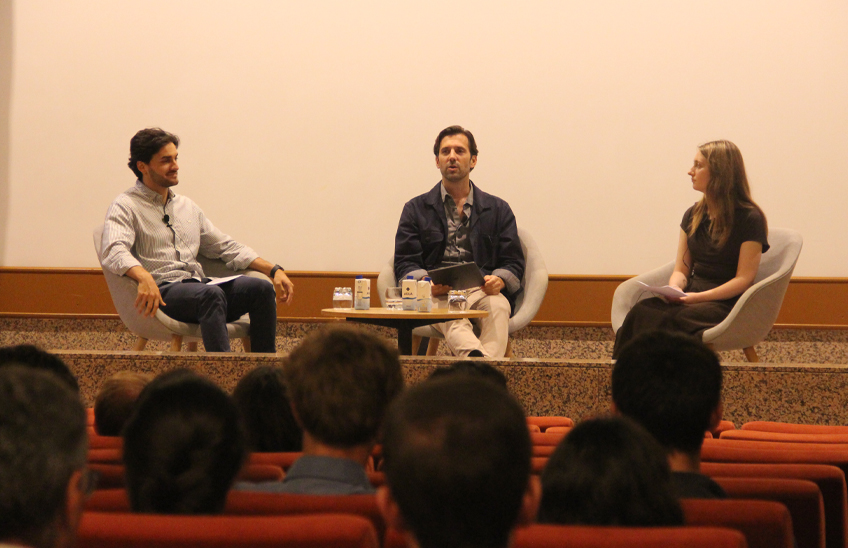
About 80 people, including students, faculty, and administrative and service staff Tecnun and Ceitcolloquium , were able to enjoy a talk with Pablo Castrillo on the topic of truth in the age of artificial intelligence. The professor and student Associate Dean at the School Department of Communication at the University of Navarra answered questions from doctoral students Guillermo Griñán and Agustina Pena.
“If we rely too heavily on AI, we lose our own capabilities and, to some extent, our own identity,” Castrillo insisted. He also referred to the potential effects of delegating certain intellectual tasks to AI, citing a study by the Massachusetts Institute of Technology (MIT). The study showed that participants who had delegated certain cognitive tasks subsequently had greater difficulty performing similar tasks on their own. “Artificial intelligence not only frees people from certain tasks, but it can also make some activities that they previously performed with ease more difficult for them,” he emphasized.
“The practice of tracking down sources and verifying them is a universal obligation”
During the Founder’s Week “ framework ,” he recalled that the University of Navarra’s motto is: “Seek and transmit the truth.” He therefore argued that if the material we are working with is generated by artificial intelligence, “we should never accept it at face value written request; we must always trace the sources.”
At the “ colloquium ” event, two students had the opportunity to ask the professor questions. Guillermo Griñán wondered how cautious young people should be when trusting this “ subject ” of tools. “I would say that this isn’t a danger specific to your generation—it’s a danger for all generations,” Castrillo replied, encouraging the students to analyze the elements of the content before reacting to or sharing it. He also addressed the images circulating on social media. “Ask yourselves whether what appears in the images makes sense, where it comes from, what the purpose of the content is, and what effect it is intended to have on the viewer,” he added.
“AI isn’t a ‘ partner ’; it’s a ‘ tool’”
Individual responsibility was another key topic of the conversation. In response to a question from student Agustina Pena about who should take responsibility for the results and potential biases of these tools, Castrillo distinguished between the “ design ” and the “uso de los sistemas.” “Responsibility for the ‘ design ’ lies with the developer. Responsibility for its use lies with the ‘ Username,’” he stated.
Castrillo distinguished the issue of plagiarism and emphasized that “AI is not a ‘ partner ’; it is a ‘ tool’.” In his view, accidental plagiarism is unlikely once certain intellectual habits have been acquired. The professor thus distinguished plagiarism from other errors that can occur when using artificial intelligence. One such error is accepting references provided by a model as valid without first verifying that they exist.
“AI is a source of chaos,” he said, referring to this problem, which, as he explained, is also affecting scientific journals. In these cases, the problem is not necessarily an intention to plagiarize, but rather a failure to do the necessary fact-checking.
The real threat lies in optimization
Castrillo pointed out that, when it comes to the idea of artificial intelligence acquiring consciousness and developing its own malevolent personality, the threat he considers most significant is related to optimization. AI models are designed to achieve specific goals with great efficiency, but that efficiency does not necessarily mean they take into account the consequences of achieving those goals.
To illustrate this, Castillo posed the scenario of a businessman using artificial intelligence to manufacture paper clips at the lowest possible cost. To do so, the AI would begin to disrupt the supply chains of the skill and cause more traffic accidents to generate more scrap metal and drive down the price of metal. In the end, the Earth would be buried in paper clips, and humanity would disappear.