
News
LATEST NEWS AND EVENTS FROM THE SCHOOL OF ENGINEERING
Gonzalo Ucar: “Those who use AI to save time and devote that time to getting more done will be the ones who make a difference in the future”
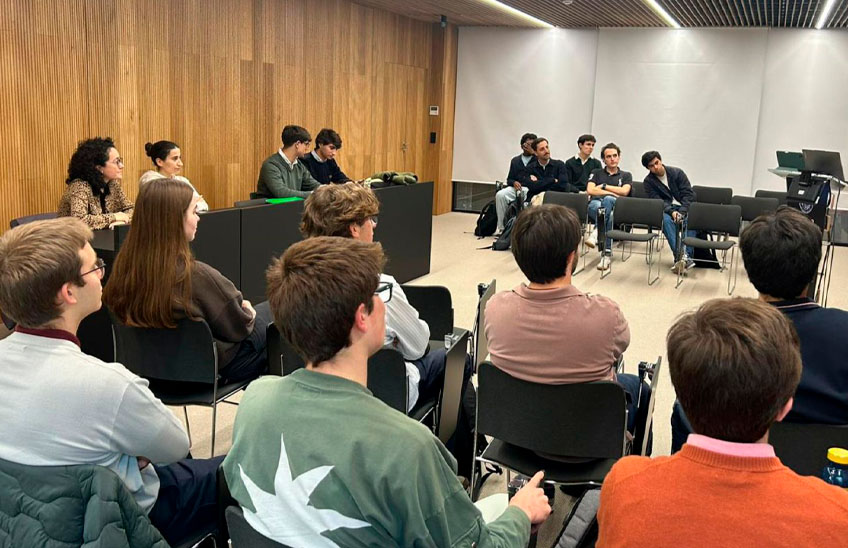
Gonzalo Ucar led a session organized by the Tecnun Gipuzkoa Chair for a group of 30 students. During the session, he discussed entrepreneurship and the use of artificial intelligence in the professional world.
16 | 03 | 2026
The engineer and former student Tecnun, Gonzalo Ucar, led a session on Friday, March 13, at 1:20 p.m. in the Degrees classroom , organized by the TecnunGipuzkoa EntrepreneurshipChair , the Innovation Club, and Innovation Factory. During the meeting, Ucar shared his professional journey as an entrepreneur with the students and reflected on the challenges of entrepreneurship and the role of artificial intelligence in the future of work.
After earning a Degree Industrial Engineering from Tecnun, Ucar began his professional career at McKinsey, but he soon realized that this path wasn’t what he was looking for. He then decided to move to Colombia, where he co-founded the company Hogaru with several partners—a project led him to live in the country for ten years. He subsequently worked for two years in the United States and is currently developing a new project in Madrid, which he launched seven months ago.
During his talk, he sought to shed light on the reality of entrepreneurship beyond the idealized image that is sometimes portrayed. “Entrepreneurship is psychologically grueling, and as such, it’s a great school of life,” he said. In this regard, he explained that it is important to be aware of the difficulties before starting a project, “so as not to lose patience along the way.” As committee students, he shared an idea that sums up his vision of entrepreneurship: “The most important thing is for each person to choose the mountain they can climb. Choose your own mountains. The higher the mountain, the greater the fall can be, and then you have to decide what to do.”
Ucar also devoted part of the session to reflecting on the impact of artificial intelligence, which, in his view, is radically transforming the way we work. “We are at a point in history where it has never been easier to create things,” he explained, noting that, in his opinion, many tasks that used to take months to complete can now be finished in a matter of hours.
In this context, he highlighted the role of engineers in the near future, noting that their greatest strength lies in their ability to solve problems. However, he also cautioned against certain risks inherent in this technical mindset, quoting a well-known saying by Elon Musk: “The problem with engineers is that they try to solve problems that should never have been solved in the first place.”
According to Ucar, AI will also change the way knowledge is valued: “Knowledge is no longer scarce. Judgment is.” In other words, today there is an overabundance of knowledge, but the ability to exercise judgment (critical thinking) is much scarcer. That is why he noted that in the coming years, the difference between professionals will be marked by how they use these tools. “Those who use AI to save themselves work but haven’t learned to reinvest the time they gain have a bleak future,” he said. He added that, on the other hand, “those who use it and dedicate that extra time to doing more will make a difference.”
Before concluding, he encouraged the students to seek out challenges that would push them out of their comfort zone. “Seek out and confront what makes you uncomfortable,” he advised. As a practical exercise, he set the attendees a challenge: to identify a real-world problem and try to solve it by creating a tool artificial intelligence, thereby putting into practice the possibilities this technology offers today.