
News
LATEST NEWS AND EVENTS FROM THE SCHOOL OF ENGINEERING
From the laboratory to society
Four researchers from Tecnun Ceit their research to the people of Gipuzkoa as framework the Pint of Science initiative
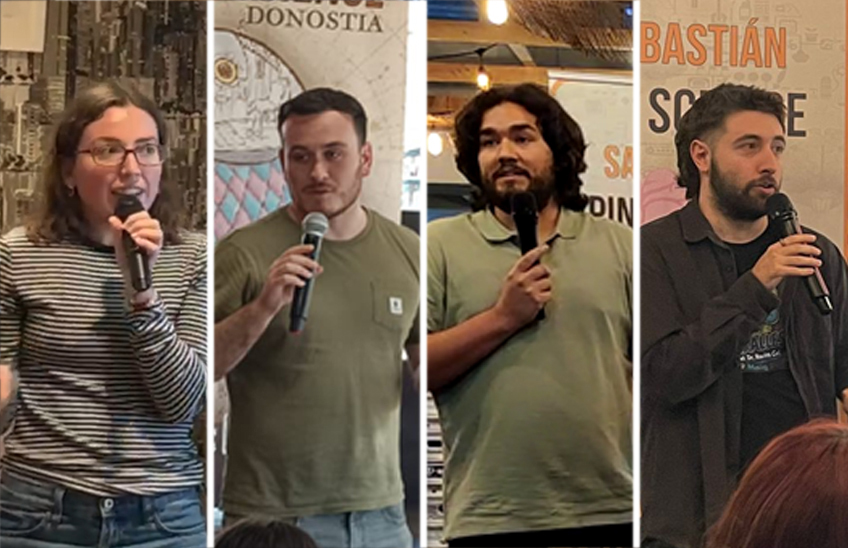
Tecnun/Tecnun left to right: Nere Arroniz, Josu Etxezarreta, Frank A. Ricardo, and Eric Rovira.
28 | 05 | 2026
Last week, four researchers from Tecnun and Ceit took part in the Pint of Science event. This international initiative invites researchers from various fields to share their knowledge with the public in relaxed settings. Thus, Nere Arroniz, Josu Etxezarreta, Frank A. Ricardo, and Eric Rovira presented their research at various venues in Gipuzkoa.
“My thesis focuses on how to improve local food logistics in Gipuzkoa”
Ph.D. student Nere Arroniz’s research focuses on an area that is as commonplace as it is invisible: freight transport. She conducts her research within the framework City Science Lab Gipuzkoa, whose goal to redesign the cities of the future based on real data and with the active participation of citizens. “How could a freight transport system be created that strengthens Gipuzkoa’s agri-food sector and facilitates the consumption of local products?” This is the question Arroniz seeks to answer in her thesis and which she discussed as framework Pint of Science framework .
The rise of e-commerce led to a Issue the Issue goods moving through cities, creating new logistical and environmental challenges. Her research involves building digital models that simulate how goods move within a given area. “These models function as interactive maps with different layers of information: population distribution, restaurants, shops, agricultural production zones, or transportation routes,” she explained. From there, the doctoral candidate test scenarios and analyzes how certain decisions affect the functioning of a city or region.
“We aim to design tools that help us better understand the limitations of Gipuzkoa and propose solutions tailored to each subject context.” Arroniz compared her models to the board game subject ”: a board where different players interact, negotiate, and make decisions based on their needs and resources. In the young researcher’s words, “the goal is goal to find the perfect solution, but to create tools that help governments, businesses, producers, and citizens understand one another and make data-driven decisions.”
“Quantum computing, one of the major technological trends of the future”
Tecnun researcher Josu Etxezarreta argued that quantum computing represents one of the major technological advancements of the future. Among its potential applications, he mentioned the design new drugs, the accurate simulation of chemical reactions, and the optimization of industrial processes. However, as he noted, “it is still far from reaching its full potential, and truly revolutionary applications will require much larger and more reliable systems.”
His exhibition on the challenges facing these technologies, namely making them “truly useful and reliable.” To explain this, Etxezarreta used a visual metaphor based on colors and bricks. He compared quantum operations to primary colors: just as a few basic colors can generate millions of shades, in quantum computing there is a small set of “gates” or operations capable of constructing any algorithm. The problem, he explained, is that these operations are extremely sensitive to errors.
That’s where quantum error correction comes in—the field in which he works. To illustrate this, he used the image of a fragile brick compared to a large block built from thousands of bricks. “A single ‘qubit’ (the basic unit of quantum information) is very unstable, but by grouping many of them together, you can create a much more resilient system. The challenge in performing operations on those large blocks without destroying the information,” noted the researcher the School.
“The use of robots to dismantle electric scooters makes it possible to recover materials that are essential for the energy transition”
Ph.D. student Frank A. Ricardo is conducting his research within the framework project “Reeproduce” project , in which Ceit is participating, and whose goal to automate the disassembly of electric scooters using robots.
During the session, Frank A. Ricardo explained that “currently, only 1% of global demand for rare earth elements is met through recycling.” This forces many countries to rely on mining and imports, which have a significant environmental impact. “We are engaging in urban mining,” he summarized, referring to the recovery of valuable materials from electronic waste.
The project he is working project involves using robotic arms equipped with cameras and artificial intelligence to disassemble devices such as electric scooters, hard drives, and mopeds. Frank explained why disassembling used products is complex: “While on an assembly line all the parts are new and placed exactly in the same spot, during disassembly each device arrives in different conditions: it may be rusty, dented, or from different manufacturers. That enormous variability requires the development of much more advanced computer vision systems,” he emphasized. For this reason, one of the project major challenges project “teaching the robot to see and move in space.” To do this, they use a camera mounted directly on the robotic arm and algorithms capable of transforming a point detected in an image into a real three-dimensional position.
Beyond industrial efficiency, the PhD student the human and environmental impact of this automation. He noted that many disassembly tasks are repetitive, physically demanding, and dangerous, especially when working with lithium batteries that can cause fires or explosions: “Robots make it possible to remove those risks from the human environment and even work in conditions that are impossible for a person, such as oxygen-free environments.”
“We need to view organic waste as valuable raw materials, not just as trash.”
Ceit researcher Eric Rovira addressed the issue of organic waste in Europe from an educational perspective, proposing that we “view it as a valuable raw material rather than mere waste.” To this end, he introduced the concept of biorefineries and devoted a significant portion of his talk to explaining anaerobic digestion technology in detail: what it is, how it works biologically, what conditions microorganisms need to function properly, and what products are obtained from the process—primarily biogas that can be used as source and nutrient-rich digestate for agricultural use. To demonstrate its practical application, he discussed the project . The presentation concluded with a reflection on the relationship between technology and real-world impact, noting that “the real challenge is challenge developing technology, but knowing where and how to apply it.”