
News
LATEST NEWS AND EVENTS FROM THE SCHOOL OF ENGINEERING
Haytham Elhawary: “Start a business in a field that matters to you, because it’s a journey that will take at least a decade.”
The engineer, a graduate of Tecnun and an entrepreneur, shared his experience with forty students from the School during a session organized by the Entrepreneurship Chair Tecnun —BIC Gipuzkoa
29 | 10 | 2026
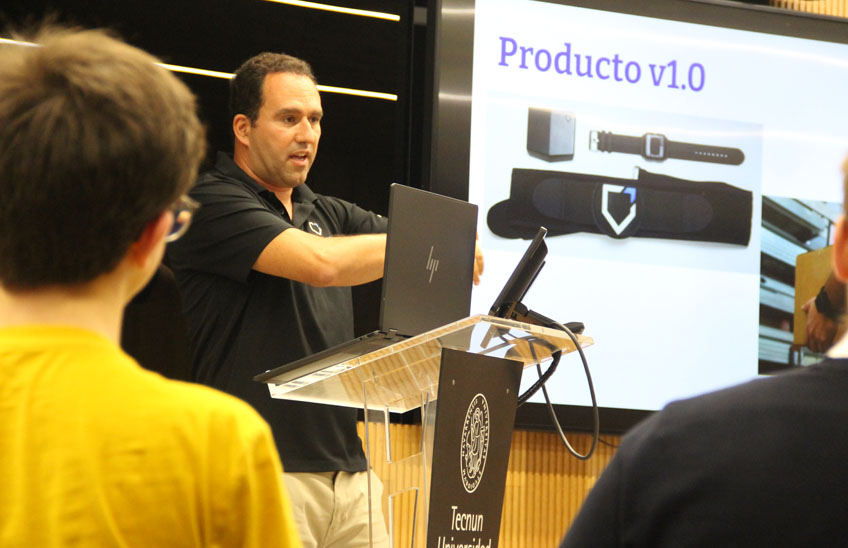
Haytham Elhawary, an engineer and graduate Tecnun and an entrepreneur, shared his professional journey with more than forty students from the School during a session organized by the Chair Tecnun Entrepreneurship Center (BIC Gipuzkoa) on Thursday, October 29, at the classroom in Degrees in the Ibaeta building. During his brief discussion paper, he explained how, in 2014, he founded Kinetic, a startup that initially developed technology to prevent workplace injuries among workers who perform repetitive lifting tasks. The idea came about when he saw how the injuries his mother suffered at work affected her well-being, her mood, and her ability to earn an income.
As he delved deeper into this issue, he discovered that a large portion of the work in the logistics sector still relied on people who handled cargo. In the United States alone, workplace injuries were costing $60 billion annually at the time. “I became fascinated by the problem and thought we had to do something,” he recalled.
However, he soon discovered that developing a viable technology was not enough to build a business. Together with his team, they created a device capable of detecting hazardous movements and alerting the worker through vibrations, but they still needed to determine whether there were customers willing to pay for it.
To achieve this, they began presenting their " proposal " at occupational safety conferences—an experience from which they drew one of their key lessons: "When you have a hypothesis, you have to conduct the experiment as quickly as possible to verify that there is a customer willing to pay for it."
For Sale
After two and a half years of development, they began marketing the technology in packages tailored to issue of employees, although all companies initially required them to go through a pilot phase. “The first thing any client will do is not believe you,” said the entrepreneur. To convince them, they had to tailor the trials to each company’s needs and understand the interests of everyone involved in the purchasing decision—from the front-line worker to the director finance department
Added to these challenges was the need to secure funding to sustain the startup’s growth. Elhawary turned to venture capital, a process he described as particularly frustrating due to the number of rejections he received. “An investor receives thirty-five emails a day from startups asking for funding,” he noted. Of the 115 investors they approached, only five agreed, although in the latest funding round they raised $4.5 million.
“Change or Die”
In 2021, after a year in which revenue had stagnated at $5 million, Elhawary faced a decision: “Change or die.” The solution was to pivot the business and shift from selling prevention technology to offering workers’ compensation insurance that incorporated its devices. To do so, they partnered with the insurance company Nationwide and completed the transition in twelve months. “Selling something that everyone has to buy is the best business,” he said. Currently, the company invoice $25 million annually.
In closing, Elhawary shared some of the lessons he had learned during his twelve years as an entrepreneur, a period marked by hard work and the need to constantly adapt. “Choose a problem that matters to you, because it’s a journey that will last at least a decade,” he advised the students. He also emphasized the importance of learning quickly and taking on unfamiliar challenges, though he acknowledged that entrepreneurship requires significant sacrifice staff and many hours of dedication.